Second Space
7 min read

In 2022 the startup hub in Kaohsiung’s Asia New Bay Area had 95 resident companies. It now reports 222. NVIDIA’s Taipei-1 supercomputer sits in a software park here rather than in Taipei, and Amazon put Taiwan’s first AWS Joint Innovation Center about twenty minutes from our Qixian branch.
Over the same period the city lost roughly 64,000 people.
Both of those are true. Most writing about Kaohsiung picks one and ignores the other, so we spent a week going through Taiwanese government statistics, city budget documents and Chinese-language reporting to work out which parts of the story actually hold up.
What NT$2.7 trillion actually bought
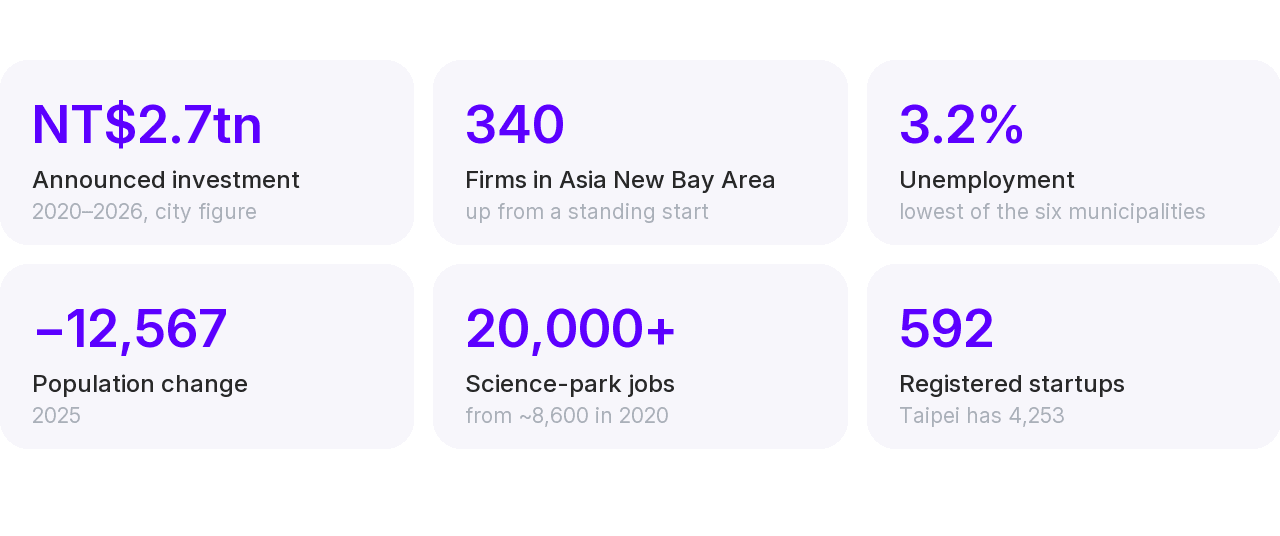
The city government puts announced investment across all industries at NT$2.7 trillion since 2020. That figure is real, but it is announced, and nobody — including the city — has published a reconciliation of how much has been spent. It is a pipeline, not a bank balance.
Some of it is unambiguous. TSMC is building fabs at Nanzih. Credible Taiwanese outlets put the investment anywhere between NT$1.5 and NT$4 trillion, and the fab count at either five or six, which tells you how early this still is. Employment in the city’s science parks went from about 8,600 in 2020 to more than 20,000 in 2025. Unemployment is 3.2%, the lowest of Taiwan’s six special municipalities.
The Asia New Bay Area programme — NT$17 billion of public money over seven years — reports 340 companies and 5,700 jobs, with Microsoft, NVIDIA, AMD, Cisco and IBM among them.
Then the part the press releases leave out. The 5G AIoT park inside that programme set itself a target of NT$30 billion in attracted investment and NT$120 billion in output value. It reached NT$15.4 billion and NT$32.7 billion. About half, and about a quarter.
There is also no official figure for Kaohsiung’s GDP. Taiwan’s statistics agency does not compile GDP at city level and says so plainly, which means every Kaohsiung growth rate in circulation is somebody’s reconstruction.
The city is shrinking, but not for the reason everyone gives
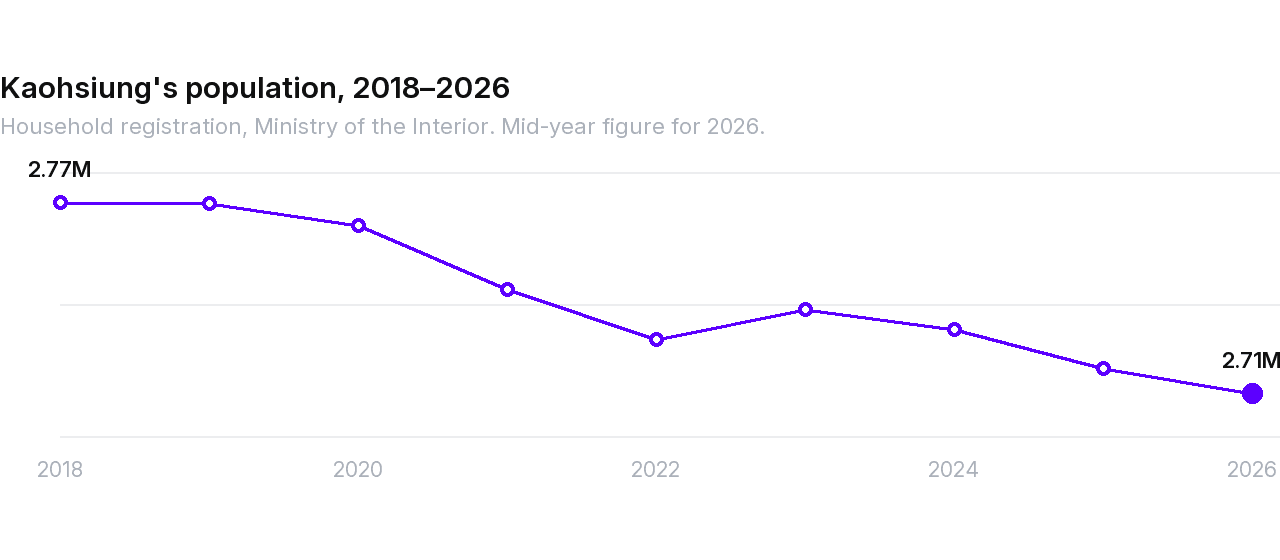
Kaohsiung had 2,773,533 residents in 2018. By June 2026 it had 2,709,973. Last year alone it lost 12,567. Taichung overtook it in 2017 and is now about 157,000 ahead. More than 20% of the population is 65 or over.
The usual explanation is 北漂 — young people leaving for Taipei. We went looking for that and the recent data does not really support it. In the first half of 2025 slightly more people moved into Kaohsiung than left, roughly 76,000 against 75,000. The population is falling because 6,320 babies were born and about 13,000 people died.
Kaohsiung is not being abandoned. It is getting old.
The district numbers sharpen the point. Nanzih gained 1,209 people and Renwu 1,355, both next to the fabs. Fengshan lost 2,175 and Lingya 2,110. The investment is producing population growth in the districts nearest the chip plants and almost nowhere else.
The money arrived on schedule. The people are a separate problem.
Getting around, and the part nobody puts in the brochure
The MRT works. Two heavy-rail lines and a light-rail loop, about 66 km in total. The loop closed in January 2024 and is the only one of its kind in Taiwan. Ridership hit a record 201,302 a day in the first half of 2026.
That is roughly where the good news stops. Only 10.2% of daily trips in Kaohsiung are made on public transport; in Taipei it is 38.3%. The Yellow Line, which would fix a good deal of that, is 12.76% built and has slipped from a 2028 opening to somewhere between 2032 and 2034.
So most people ride a scooter. Kaohsiung has 183.9 motorcycles per 100 households, the highest rate in Taiwan.
Which brings up the number that deserves more weight than it usually gets. Taiwan recorded 2,858 road deaths in 2025 — about 12.2 per 100,000 people, against roughly 1.1 in Japan and 2.2 in South Korea. Japan counts deaths within 24 hours and Taiwan within 30, so the true gap is nearer nine times than eleven. It is still close to an order of magnitude, and Kaohsiung has led Taiwan in road deaths for seven years running.
If you move here you will spend a lot of time beside scooters. That is the honest trade.
What it costs, and what you breathe
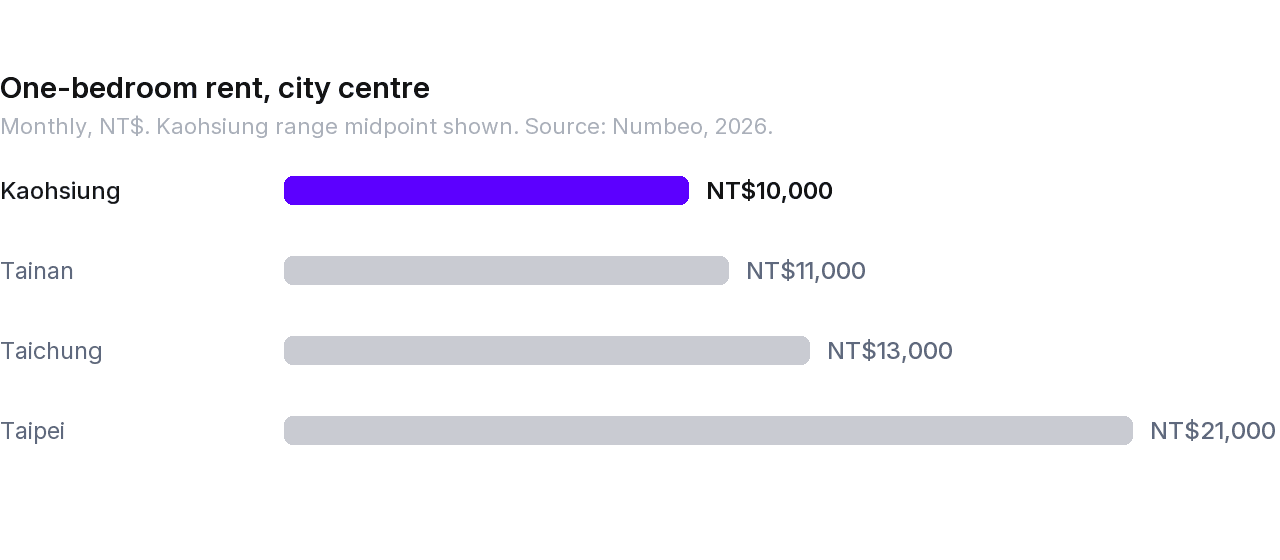
A one-bedroom flat in central Kaohsiung runs about NT$8,000 to NT$12,000 a month. The same thing in central Taipei is around NT$21,000. Overall living costs come in 16–21% below Taipei depending on the index.
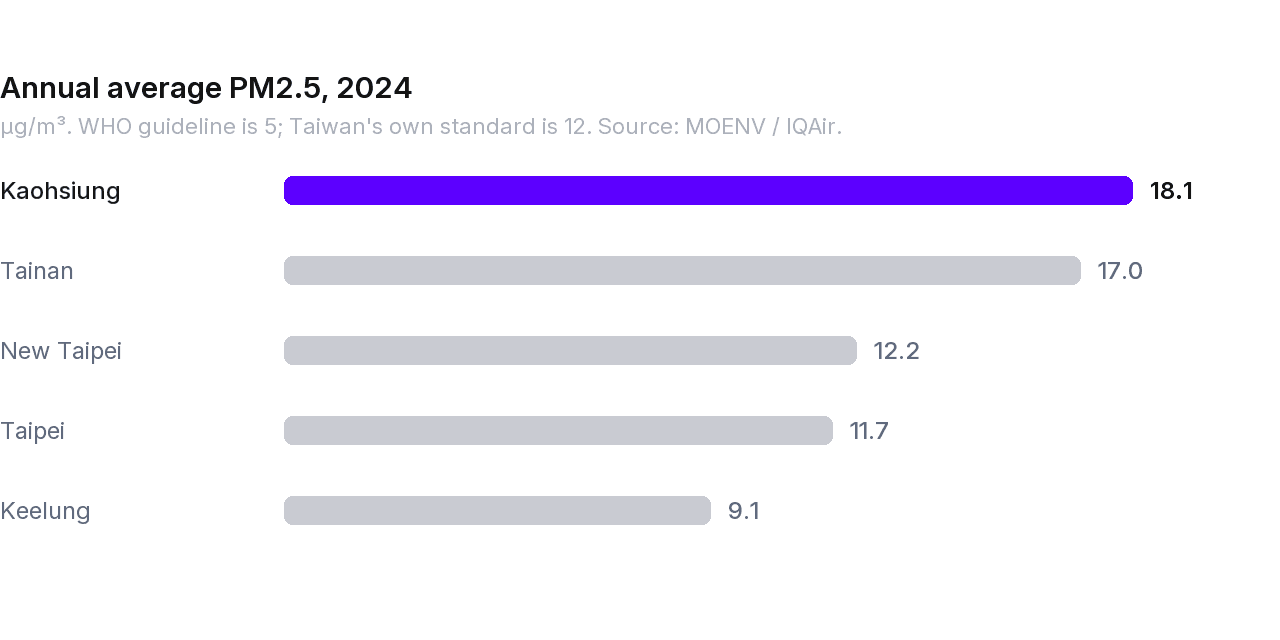
Air quality is the criticism that has aged worst. Taiwan’s national PM2.5 average fell 24% in a single year, from 17.5 to 13.3 µg/m³. Kaohsiung is still among the worst in the country at roughly 17 to 18 — about 1.5 times Taipei and three and a half times the WHO guideline — and the city’s own abatement plan concedes it will still be above the national standard in 2027.
It is seasonal, though. The bad stretch runs September to April. On the afternoon we were checking, a Kaohsiung monitor read 3 µg/m³.
The weather is the criticism people underrate. Kaohsiung is muggy for 9.1 months of the year, and every single day in July qualifies.
The visa genuinely changed
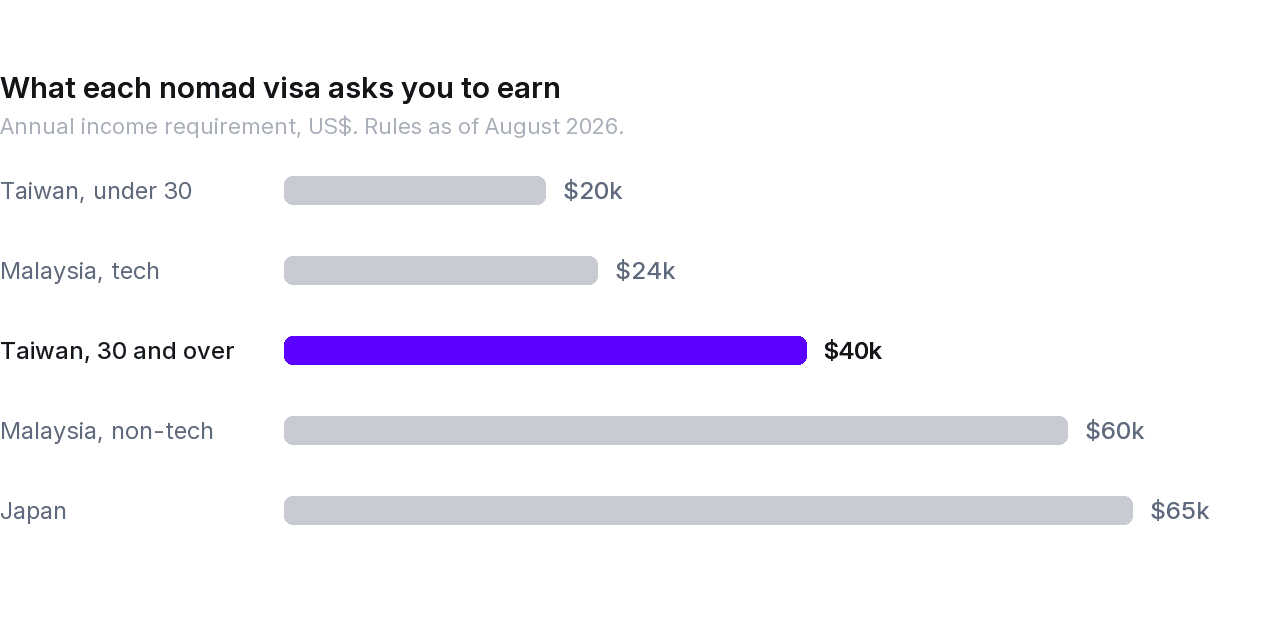
Taiwan launched a dedicated digital nomad visa in January 2025, and in January 2026 extended the maximum stay from six months to two years — an initial six months plus up to three further six-month extensions.
You need to hold a passport from a country with visa-free entry, and to meet one of three conditions: you already hold a nomad visa from another country; or you are 30 or over and earned at least US$40,000 in either of the last two years; or you are 20 to 29 and earned at least US$20,000. Separately, you need an average bank balance of US$10,000 over six months. Both tests apply, which catches people out.
Regionally that puts Taiwan in the middle. Japan asks for about US$65,000 and gives you six months with no renewal. Malaysia’s DE Rantau asks US$24,000 from tech workers and runs up to three years. Thailand’s DTV is cheaper, easier and valid for five. Taiwan beats Japan comfortably on duration and loses to Thailand on both duration and cost — the savings requirement in particular is unusual.
If you clear a much higher bar, the Employment Gold Card remains the better instrument, and it carries open work rights rather than remote-only ones.
So is it a good place to work remotely?
That depends on what you need from a city, and the thing most people assume they need is the thing Kaohsiung has least of.
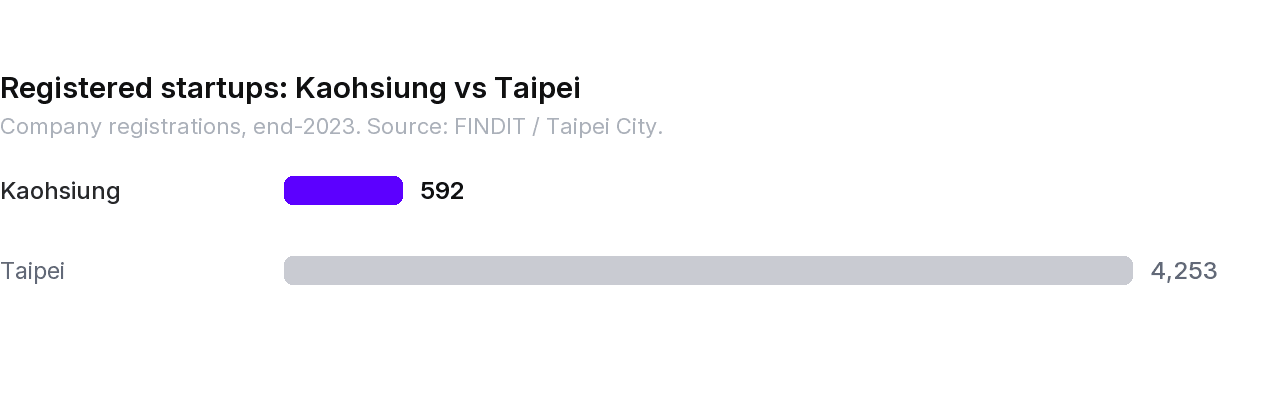
Kaohsiung had 592 registered startups at the end of 2023. Taipei had 4,253. More than 90% of Taiwan’s venture capital firms are in Taipei. For 2026, dev.events lists one tech conference in Kaohsiung and eighteen in Taipei. The largest local venture fund is NT$400 million, which is roughly one Taipei Series A.
The buildings arrived before the ecosystem did.
That matters less than it sounds if you already have your income. Someone on a foreign salary is not raising a round or hiring a senior team here — they need cheap space, fast internet, decent healthcare and a city that functions. Kaohsiung does all four, and it is quietly improving at them while Taipei gets more expensive.
It matters a great deal if you are a software founder who needs peers, investors and a hiring pool. For that, go north. If you are building hardware, medtech or anything adjacent to manufacturing, the calculation turns again — the supply chain is world-class and fifteen minutes away rather than a flight.
Come for the cost, the climate and the room. Do not come expecting a startup scene that is not here yet.
The most interesting thing we found is not in any of the charts. A city that is shrinking and investing heavily at the same time is unusual, and it produces a strange, temporary window: real infrastructure, real jobs arriving, and none of the crowding or pricing that normally follows. Rents in the tech districts actually fell in 2026 — Nanzih by 9%.
Windows like that do not stay open indefinitely. This one is open now.
SS
Second Space
A 24/7 coworking space and members club in Kaohsiung, Taiwan. Two branches, no reception desk.

