Second Space
6 min read

In the week of Meet Greater South 2026, a group of international founders spent an afternoon at Second Space in Kaohsiung. Informal pitches, then feedback from people who already work in the city. Meet Global’s account of the visit thanked Arturs Vancans for introducing the group to the local startup community.
That afternoon is a useful place to start a story about an exhibition, because it is where a conversation got far enough to be worth having again.
The show itself ran on August 28–29 at the Kaohsiung Exhibition Center’s North Hall. Its theme, “Meet Your BEST Solution”, put a practical job in front of everyone who attended: find a business problem worth solving, and someone capable of working on it. The harder part starts when the stands come down.
The attendance figure needs its unit
The closing report records 280 exhibitors, more than 13,000 visits, 167 teams pitching and nearly 300 business and investment matchmaking sessions. Those figures describe the completed 2026 event. Earlier opening coverage used “more than 250” exhibitors, so 280 is the more useful number for a recap.
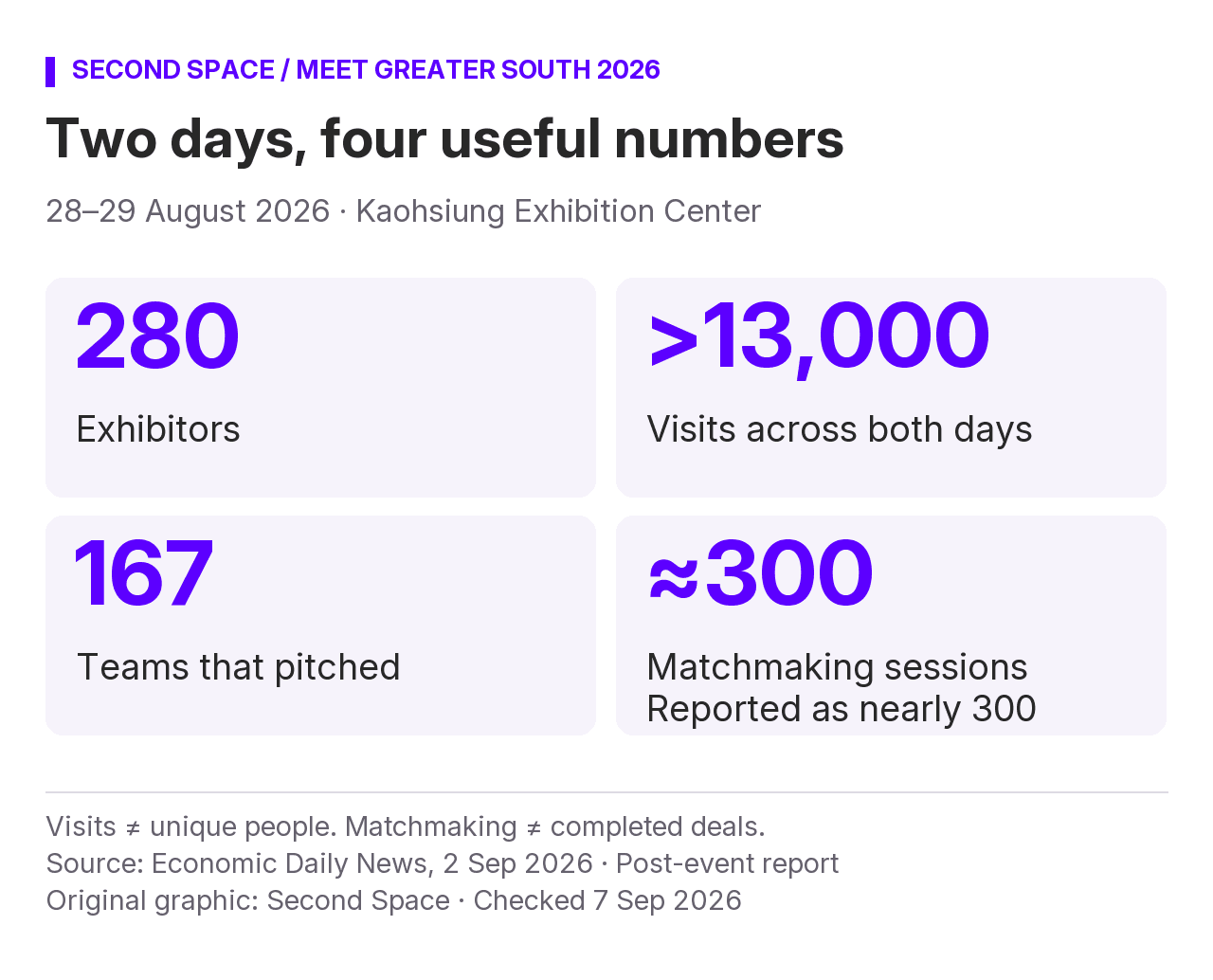
Graphic: Second Space. Data: the post-event report of 2 September 2026. Figures cover the two exhibition days.
The distinctions matter. A visitor returning on Saturday can contribute another visit. A scheduled conversation does not tell us whether a purchase followed. The published recap gives us a measure of participation; it does not establish a conversion rate from introductions to paying customers.
That still leaves something substantial. A founder could explain a product, hear a buyer’s objection and adjust the explanation while the event was still running. That short feedback loop is a better reason to value the show than the size of its audience. A busy aisle gets someone to stop. A useful conversation gives them a reason to reply next week.
The customers were already here
Meet Greater South has been working on this connection for several years. The inaugural Kaohsiung edition ended on December 11, 2021, and the Youth Bureau’s report at the time described an effort to connect established industries needing digital upgrades with young companies needing commercial opportunities. That is the setting the 2026 show inherited.
This year’s six exhibition areas made the intended customers easier to recognise. They covered manufacturing, business operations, health and elder care, energy and carbon management, retail and food services, and branding and overseas marketing. The organiser grouped these around the problems a business brings to the hall.
For a small technology company, that changes the first conversation. A factory manager needs to explain where inspections slow down. A restaurant operator needs to describe a difficult shift. The founder needs to find out whether the product fits the work as it is actually done.
Those are demanding conversations. Someone who already runs a production line has existing equipment, deadlines and a limited appetite for disruption. Proximity to that person is useful precisely because they can point out what a presentation leaves out. Southern Taiwan’s industrial setting gives this exhibition a concrete starting point.
A demonstration should survive a specific problem
The local exhibits offered examples. The Kaohsiung Youth Bureau brought 15 teams in 2026. One was 海涯國際, whose TF-100 concept combines an unmanned surface vessel with a tethered drone for fisheries work. Its proposed use is specific: finding fish while reducing reliance on risky helicopter searches. That is the bureau’s description of the application, not an independently measured result from the exhibition.
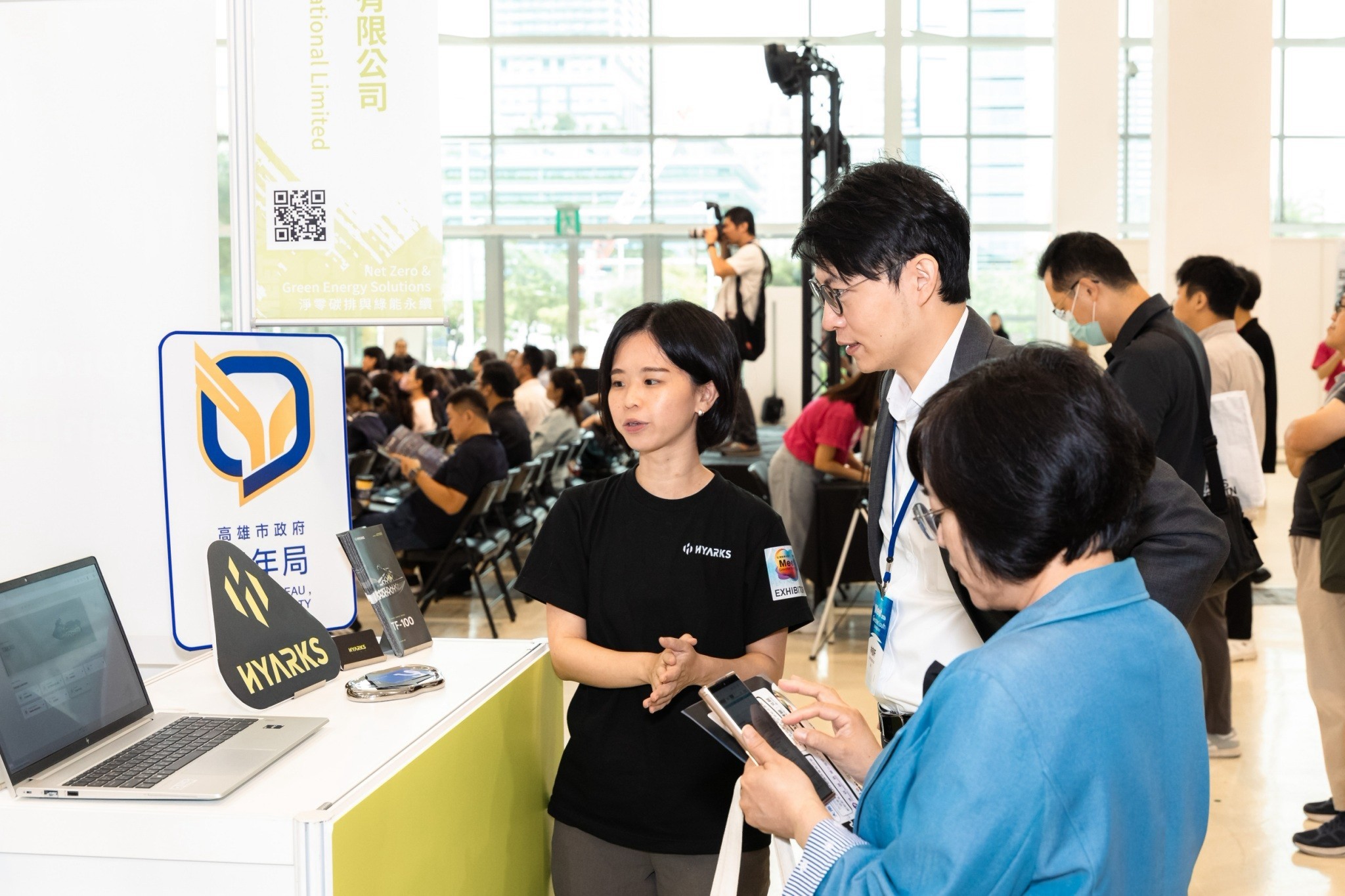
The 海涯國際 booth at the 2026 exhibition.
UnariQ’s exhibition announcement focused on training and checking robot behaviour in simulation before moving to a physical arm, combined with AI vision. It is a useful example of a question industrial customers ask: how do you test a change before it touches equipment? The announcement documents the planned exhibit; it does not establish production performance.
EvoFlow’s recap describes a different kind of demonstration. At its Global Pavilion stand, visitors described a workflow and watched Atlas turn it into a map of steps and handovers. The value of that format is easy to understand: both sides have a concrete process in front of them, and the visitor can correct it.
The useful demonstration begins with the visitor’s problem.
The international programme had a local address
International participation also needs a practical form. A place in an exhibition gives a visiting founder visibility. Time with people who work locally gives that founder a chance to ask less polished questions, including whether the proposed customer is even the right one.
The organiser’s tour updates put Second Space on day two of the programme before the exhibition, and name Arturs among the mentors supporting the visiting startups. That documents our part in the week: hosting an exchange with the local community, and contributing feedback.
This is where the story gets smaller, and more useful. An international programme becomes a particular afternoon in a particular room. A founder can explain something twice, hear a different objection and work out whom to speak to next. The return on that time may arrive well after the event has stopped counting visitors.
For a shared workspace, this is a job worth taking seriously. Introductions need enough context to continue. The person receiving one should know why the other person is relevant and what they are trying to find out. Hospitality gets people through the door. A clear reason to reconnect gives the afternoon a life beyond it.
The following week needs an owner
Our suggestion for anyone leaving this kind of event is deliberately small: choose one promising conversation and make the next step specific. A follow-up should name the problem discussed, the person responsible for responding and the information needed to make a decision.
For a proposed trial, write down its boundary. Which workflow or machine is involved? What access is needed? How long will the trial run, and what result would justify continuing? These are suggested questions, not a description of contracts signed at Meet Greater South.
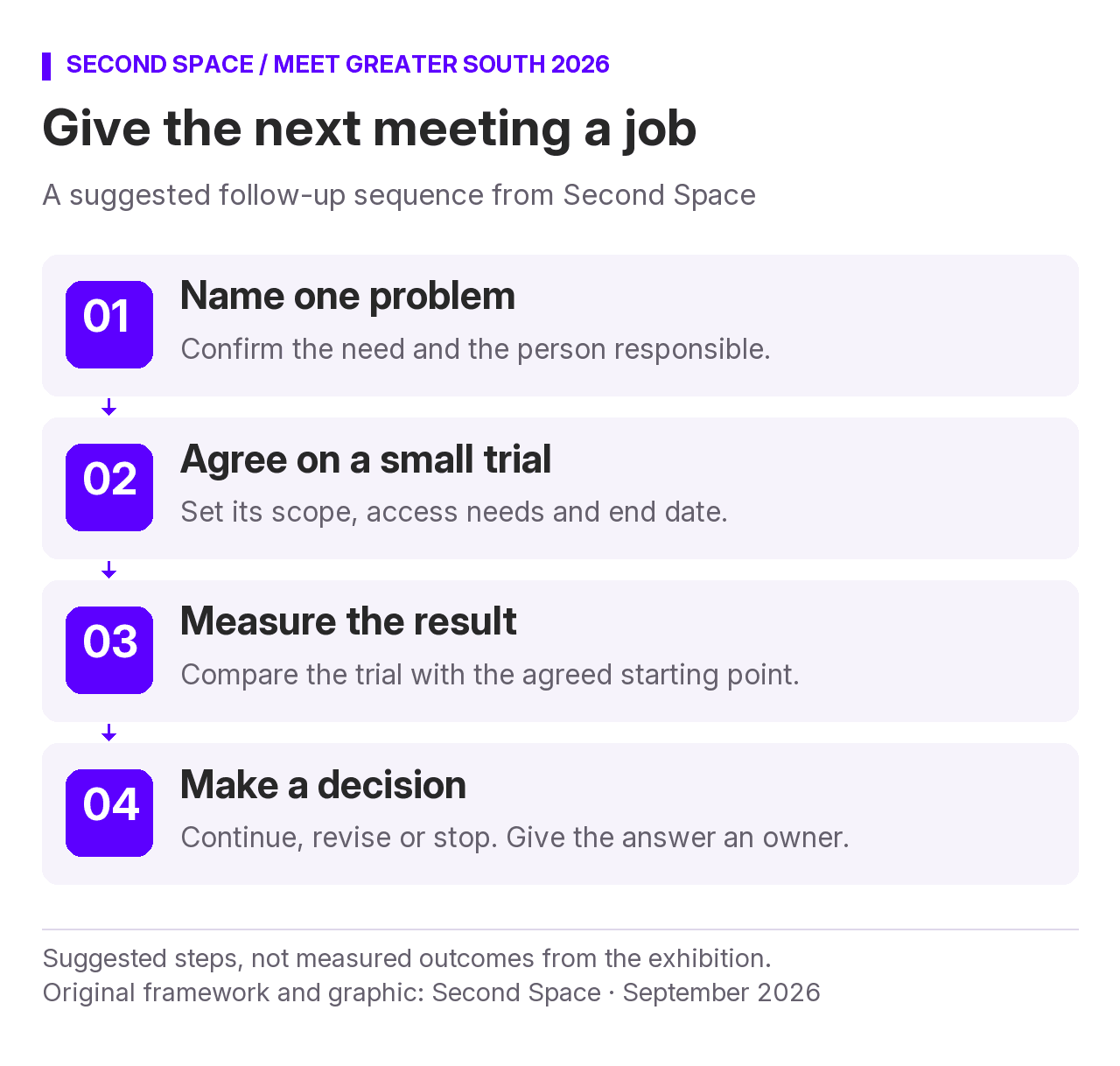
An editorial framework from Second Space. The diagram suggests a way to follow up; it does not represent measured outcomes from the event.
The same discipline applies to an introduction that does not involve a product demo. A visiting founder might need an industry contact, or feedback on a customer assumption. If both sides understand the request, a short second meeting can be enough. If neither does, a long email praising the event will not fix it.
A decision to stop can be useful too. Finding out that a product does not fit a customer’s process is information the founder can use before spending another month on it.
A reason to come back
In our earlier look at Kaohsiung, we argued that investment in buildings and infrastructure runs on a different timetable from the growth of a working community. Meet Greater South adds a concrete example: people arriving, explaining what they do, and meeting potential collaborators in the city.
The event’s longer-term value will depend on repetition. A second visit lets someone ask what happened to the trial. A regular local contact can help a newcomer understand an answer that seemed straightforward in the exhibition hall. Neither outcome follows automatically from a full calendar.
That gives places like Second Space something to do throughout the year. Our events provide occasions to meet again; the useful work is making those meetings relevant. Hosting the tour was one instance of that, and the next conversation deserves the same attention as the first.
The stands came down on August 29. The harder part is still open.
Exhibition photographs: Youth Bureau, Kaohsiung City Government, reproduced with attribution under its website open-data notice.
SS
Second Space
A 24/7 coworking space and members club in Kaohsiung, Taiwan. Two branches, no reception desk.
READ NEXT
